At Wisdom Panel™, we apply the latest and greatest science to help vets and pet parents provide the best possible care for their dogs and cats. And we’re thrilled to share that our new breed detection system is more accurate and efficient than any other.
How? Well, to accurately detect a dog’s breed mix, you need three things:
- The ability to collect data at key locations (variants) across the dog’s genome
- A sizeable reference database of genetic samples from verified breeds
- A sophisticated set of algorithms to process all the data and make ancestry classifications
Thanks to 20+ years of collecting high-quality genetic samples from across the globe, we have the world’s largest breed database of 31,000+ samples with known breed background. Our test is also powered by a phasing panel of more than 250,000 samples. Phasing lets us read DNA as meaningful inherited chunks rather than scattered pieces, making ancestry results more precise and reliable—and giving pet parents the most comprehensive breed detection available.
And, to prove it, in benchmarking tests using mixed-breed samples, our breed detection system consistently showed error rates that were 2-4x lower than the industry standard.
What’s all this mean for you? Wisdom Panel™ can scan your dog’s DNA for the most breeds and give you the most accurate answers about their ancestry.*
How we built an ancestry detection system that will only improve over time
Several years ago, we recruited some of the world’s leading experts in population genetics from 23andMe and AncestryDNA. And right away, this team began assembling reference datasets and running experiments to identify the optimal elements of a breed detection system.
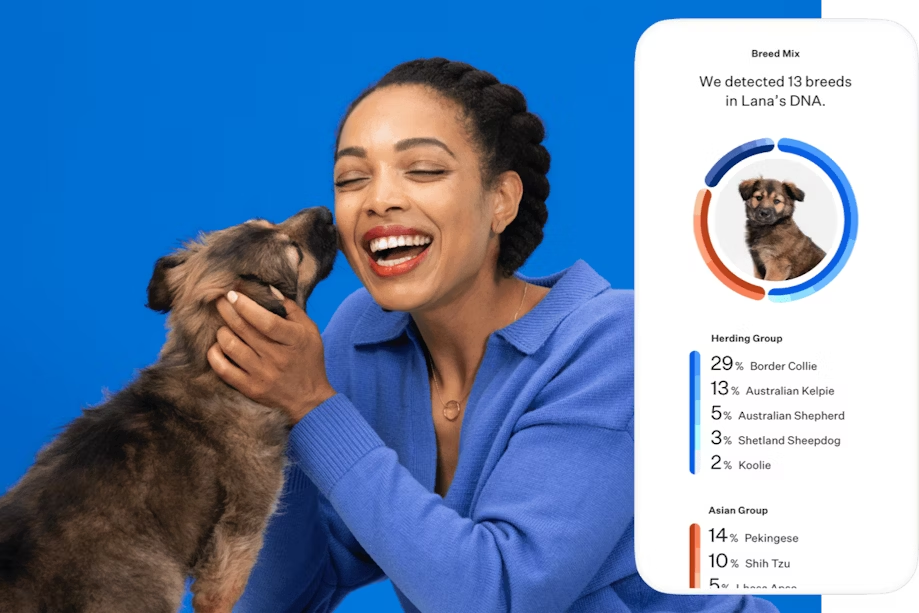
At the outset, our scientists reasoned that a very large and global reference panel of known dog DNA breed samples would capture more of the genetic diversity across dog populations. And that would ultimately allow us to deliver higher degrees of accuracy and precision (e.g., reporting breed mix down to 1%) to our customers.
Our team also knew they wanted to build a local ancestry classifier—one that could pinpoint ancestral breeds to specific segments on a chromosome/chromosomes—because it would provide more precise estimates and support a variety of our ongoing dog health studies.
To rise to this challenge, we needed to solve inefficiencies that have hamstrung population geneticists since they started using DNA to predict ancestry. In short, we had to reduce computing power and increase speed. And we succeeded—developing a method that’s 30x more efficient than alternatives and designed to scale accurately as our database grows.
The end product uses the positional Burrows-Wheeler transform (PBWT) algorithm along with our own novel mathematical approximation to the local ancestry model of Li and Stephens, often referred to as “chromosome painting.” It also involves a machine learning program with a reference panel of common misclassifications. This allows the system to learn which errors to watch out for and smooth the results to improve overall accuracy.
As a final step, we subjected our new breed detection system to a range of quality tests which we believe set a new standard in the (human, dog, or cat!) genetic testing industry. We’ve detailed all of our methods and testing in a white paper and a patent application filed on July 7, 2021.
And, it hasn’t stopped there! As science and technology advances, so do we at Wisdom. In May of 2026, the breed classification system received an update to boost its already highly accurate breed prediction ability.
With this update, 65+ new breeds were included – increasing our dog breed library to 430+. And, 4,000 more dogs were added to what is already the world’s largest breed reference panel.
Additionally, the breed detection system experienced refinement on identifying purebreds with more complex breed backgrounds, such as seen in landrace populations. These algorithm advancements were possible thanks to the never-ending work by our research team.**
Dig into the technical details
We’ll share more about how our industry-leading breed detection system works in a future post. But in the meantime, you can find more information in our white paper.
Read White Paper (PDF)*All DNA samples tested on or after June 2, 2026 will get results from the latest (BCSYS1.2) breed detection system, which includes the detection of 65+ additional dog breeds and performs against our 31k+ dog breed reference panel.